
The world’s first biological computing centre uses 16 million living human neurons for data processing
Researchers in Singapore have just unveiled the prototype of a novel data centre that uses living human neurons to process information, instead of relying entirely on silicon chips.
The project was initiated by the Yong Loo Lin School of Medicine at the National University of Singapore (NUS Medicine). The university collaborated with data centre developer DayOne and biocomputing startup Cortical Labs to develop the prototype.
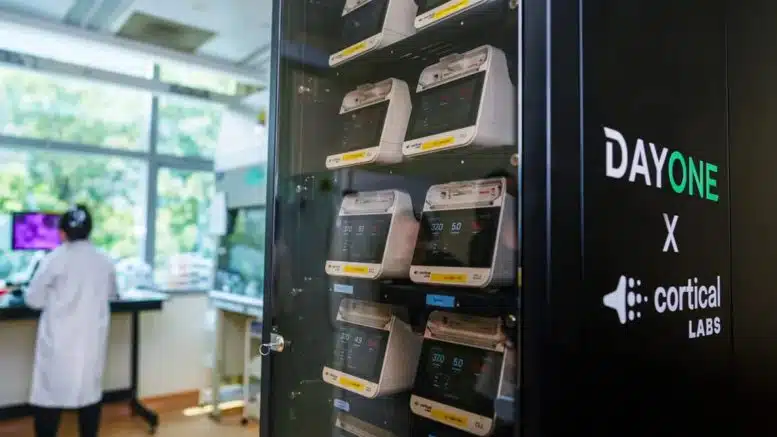
The Biological Data Centre, established at the NUS Life Sciences Institute, consists of 20 CL1 biological computing units. The CL1 is the world’s first commercially available, programmable biological computer. It is powered by 800,000 laboratory-grown human brain cells.
Rickie Patani, PhD, Professor of Neuroscience at NUS Medicine, pointed out that this is the world’s first independently operated, biologically integrated server rack. “This partnership marks a real shift in the way we think about computing and its broader scientific potential,” said Rickie Patani, PhD, Professor of Neuroscience at NUS Medicine.
Brain cells at work
Traditional data centres are based on silicon processors and general-purpose central processing units (CPUs). They typically use standard air cooling to handle workloads such as cloud computing, web hosting, and database storage.
Biological computing, on the other hand, uses wetware for data processing. This wetware consists of living neurons grown from stem cells. The neurons are connected to computer hardware via microelectrode arrays. These arrays enable the transmission of electrical signals between the biological cells and digital systems.
This approach holds a twofold promise. “By growing living human neurons from stem cells and combining them with cutting-edge technology, we are not only creating a more efficient alternative to silicon, but also a platform that can help us understand learning and adaptation at their biological source ,” Patani added.
The team presented the system on August 6th. The event included the integration of microelectrode arrays and real-time neural network activity. More than 80 guests saw the CL1 and Cortical Cloud units in operation.
Ready for real-world deployment
NUS Medicine will provide the expertise for maintaining the living cells. The team will cultivate and maintain them under Patani’s leadership. The researchers anticipate that biological computing could be powered by a fraction of the energy required by conventional digital computers.
This could become increasingly important as AI increases the electricity consumption of data centres. According to the IEA (International Energy Agency), the electricity demand of data centres rose by 17 percent in 2025.
According to Cortical Labs, the technology could complement AI, especially for tasks where little data is available. The company states that living neural systems can learn from limited information and adapt to changing conditions.
According to Hon Weng Chong, founder and CEO of Cortical Labs, potential applications include drug discovery, humanoid robotics, cybersecurity, and fraud detection. “Ultimately, it’s about offering a more sustainable path for the technologies humanity depends on,” Chong explained in a press release.
Jamie Khoo, CEO of DayOne, explained that the project could help bring biological computing to market.
“We are proud to be working with world-class partners in one of the world’s most sustainability-focused markets to help translate cutting-edge scientific research into practical applications,” Khoo concluded.
yogaesoteric
September 18, 2026