
Rumsfeld’s “new Europe” is becoming reality: The USA is not withdrawing – it is shifting its military power eastward
Donald Rumsfeld was not just any American Secretary of Defense. Under President George W. Bush, he was one of the key political and military figures responsible for the US-led invasion of Iraq in 2003. The war was justified to the public, among other elements, by alleged Iraqi weapons of mass destruction, which were later never found. The consequences were devastating: The Brown University Costs of War project estimated at least 134,000 civilians killed by direct military violence in Iraq during the first ten years of the war and indicated that the actual number was likely higher. For the wars and military operations in Iraq and Syria since 2003, the project now estimates a total of 550,000 to 580,000 deaths.
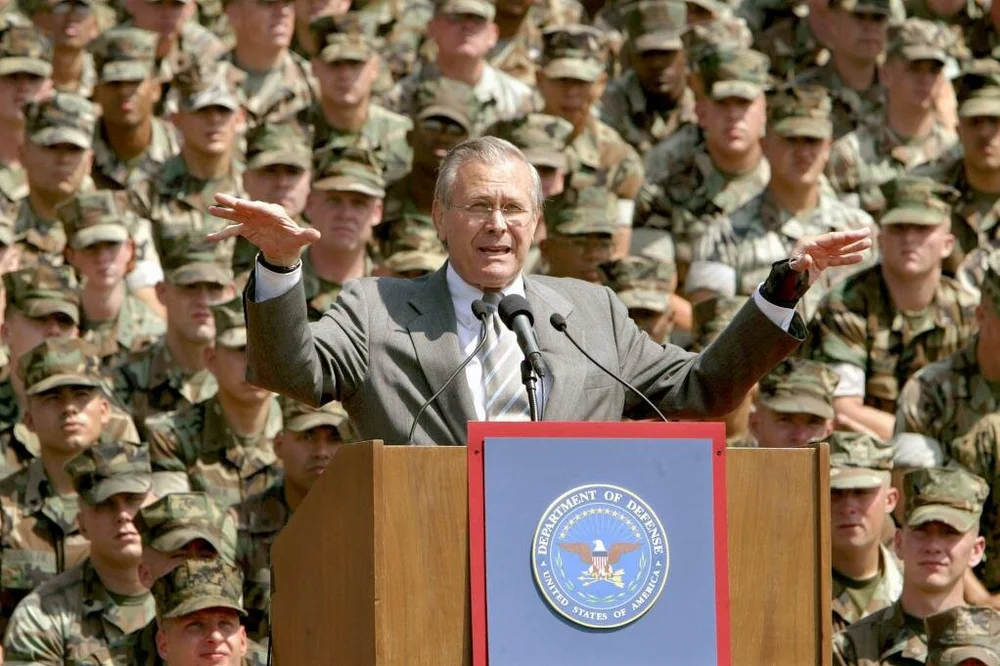
Ironically, Rumsfeld himself shaped a vision of Europe just weeks before the start of the Iraq War, a vision that seems remarkably relevant again more than two decades later.
On January 22, 2003, Rumsfeld was asked why Germany and France did not support Washington’s course of action against Iraq. His answer became famous. For him, Germany and France represented “old Europe.” The centre of gravity of Europe was shifting eastward, the then-Pentagon chief explained. Many Central and Eastern European states stood not behind Berlin and Paris, but behind the United States.
A recent article by José Niño, published by the Libertarian Institute, takes up this point again. His central thesis: Rumsfeld’s vision of an eastward-shifted Europe could be experiencing its second act today. While Germany, as the traditional centre of American military presence, could lose importance, Poland, Romania, and the Baltic states are increasingly moving into the focus of US strategy.
The developments began immediately after Rumsfeld’s remarks. France and Germany wanted to give the UN weapons inspectors in Iraq more time and rejected Washington’s war policy. In contrast, Great Britain, Spain, Italy, Portugal, Denmark, Poland, Hungary, and the Czech Republic sided with the US in the so-called “Letter of Eight.” Shortly thereafter, the foreign ministers of the so-called Vilnius Group also supported Washington’s position.
In May 2003, the US Senate voted 96-0 in favour of admitting Bulgaria, Estonia, Latvia, Lithuania, Romania, Slovakia, and Slovenia to NATO. A year later, all seven countries became members of the alliance. This expanded NATO’s eastward reach and, for the first time, included three former Soviet republics.
But it wasn’t just a political shift. American soldiers and military infrastructure followed suit.
In 2004, the Bush administration announced a comprehensive reorganization of the American military presence. Between 60,000 and 70,000 US military personnel were to be repatriated in the long term, while heavy units were to be withdrawn from their traditional bases in Germany. At the same time, Romania and Bulgaria opened military facilities to rotating American units.
In 2008, Bush pushed for the possibility of future NATO membership for Ukraine and Georgia. That same year, war broke out between Russia and Georgia.
Even under Barack Obama, military infrastructure continued to migrate eastward. The American missile defence system in Deveselu, Romania, became operational in 2016. Following the 2014 Crimean crisis, NATO deployed multinational combat units to Poland and the three Baltic states.
Donald Trump continued this trend during his first term. In 2019, the US withdrew from the INF Treaty on land-based intermediate-range missiles. In 2020, Washington and Warsaw agreed to establish a forward headquarters for the US V Corps in Poznań, Poland.
Under Joe Biden, NATO’s eastern flank was significantly reinforced following the start of the war in Ukraine in 2022. The number of American troops in Europe temporarily rose to around 100,000. In March 2023, the US military opened its first permanent garrison in Poland. In July 2024, NATO also declared the American Aegis Ashore missile defence system in Redzikowo, Poland, operational.
Thus, Rumsfeld’s political “old Europe” and the eastward shift in focus had long since become a military reality.
The article recalls at this point a man who warned precisely about this development: George Kennan, one of the key architects of the American policy of containment toward the Soviet Union. As early as 1998, Kennan described NATO’s eastward expansion as a grave mistake. He anticipated that Russia would react and that a new Cold War could erupt.
However, under Donald Trump’s second presidency, this development is now gaining new momentum.
In October 2025, the Pentagon withdrew a brigade of the 101st Airborne Division from Romania without immediately replacing it. The US military explicitly stated that this did not signify an American withdrawal from Europe or a weakening of its commitments to NATO. Rather, the decision was a sign that European allies were increasingly able to assume responsibility themselves.
However, the shift becomes particularly noticeable when comparing Germany and Poland, as the article describes.
Following the dispute between Trump and German Chancellor Friedrich Merz over the Iran war, the Pentagon announced on May 1, 2026, the withdrawal of approximately 5,000 American troops from Germany. According to American defence officials, a missile battalion originally intended for Germany would also be relocated.
Just three weeks later, a completely different message for Poland came from Washington.
Trump announced an additional 5,000 American troops for Poland, explicitly referencing his relationship with Polish President Karol Nawrocki. However, Polish Foreign Minister Radek Sikorski downplayed the announcement, stating that the additional troops would only result in the American troop strength remaining roughly at its current level.
In his article, José Niño sums up the development with a simple formula: the “old Europe” is being punished, the “new Europe” is being rewarded.
This is the author’s interpretation and not an officially declared American doctrine. However, the underlying shift is evident: Germany is losing American soldiers, while Poland is becoming an increasingly important military base for the US and NATO.
The further course of the war in Ukraine could play a decisive role in this.
In July 2026, former US diplomat Thomas Graham of the Council on Foreign Relations outlined a possible peace settlement in which the front line would be frozen. Ukraine could maintain security relations with the West but would not become a member of NATO, while further eastward expansion of the alliance would be prevented.
Should such a scenario occur, Washington could, according to Niño’s assessment, concentrate its military resources even more heavily on those Eastern European countries that are already NATO members. Poland, Romania, and the Baltic states would then be at the forefront.
However, there is no question of an American withdrawal from Europe. According to the Congressional Research Service, cited in the article, around 86,000 American military personnel were still stationed in European NATO countries in March 2026. Furthermore, the US Congress requires special certification before this number can fall below 76,000.
At the same time, NATO member states have committed to increasing their defence and security-related spending to a total of five percent of their economic output by 2035. Military bases, headquarters, and other structures for a long-term presence on NATO’s eastern flank are therefore already in place.
That is precisely the article’s main point: The US may not be leaving Europe – it is shifting its military focus within Europe.
Germany, for decades the centre of the American military presence on the continent, could lose relative importance. Poland, Romania, and the Baltic states, on the other hand, are moving closer to the centre of American security strategy – and thus simultaneously closer to the direct line of confrontation with Russia.
Niño warns that these structures could outlast Trump. A future American administration would not need to create a new military architecture. Bases, headquarters, and troop structures would already be in place. Rumsfeld’s “new Europe” could thus become a permanent military front against Russia.
yogaesoteric
October 2, 2026