
The next stage has been confirmed: Europe is already preparing troops for Ukraine
While public discourse continues about a ceasefire and peace negotiations, the so-called Coalition of the Willing is already creating military facts for the period afterward. The official declaration of August 24th shows that Great Britain, France, Germany, and their partners not only intend to continue their military support for Ukraine, but also to establish a permanent security architecture that includes a multinational force on Ukrainian soil.
The crucial point is almost inconspicuous towards the end of the declaration: The coalition will continue to prepare the “Multinational Force Ukraine” so that it can be deployed as soon as a “credible cessation of hostilities” is achieved.
This is no longer just about arms deliveries. It’s about preparing for a Western-led military presence in Ukraine.
The group doesn’t just exist on paper.
The document becomes even more explosive when combined with an official statement from the British Ministry of Defence dated July 24.
The Multinational Force Ukraine already has a command structure.
British Lieutenant General Tom Bateman has assumed command. The operational headquarters is located in Paris. Following a cessation of hostilities, an additional headquarters will be established in Kyiv. The planned tasks extend far beyond symbolic observer duties: the force will assist in the reconstruction and training of Ukrainian ground forces, secure Ukrainian airspace, and support maritime operations.
The British government even described the force as “Ready to Operate” in July.
An official British-French-Ukrainian declaration of intent goes even further: it explicitly provides for the deployment of British, French, and other armed forces of the “Multinational Force Ukraine” on Ukrainian territory. Their tasks are to extend to land, air, and sea. The deployed forces are also to be authorized to use force to fulfil their mission and for their own protection.
A ceasefire does not therefore mean demilitarization.
The next stage is no longer speculation. Europe is concretely preparing a military presence in Ukraine – including a command structure, deployment planning, and the potential use of force. However, according to official documents, this presence will only take place after a credible cessation of hostilities.
According to the coalition’s vision, a ceasefire would not necessarily lead to a military disengagement between Russia and the West. On the contrary.
After the end of hostilities, a new phase could begin in which European armed forces are officially present in Ukraine, continuing to train and equip Ukrainian troops and securing parts of Ukrainian air and sea space.
This would further integrate Ukraine militarily with European states – even without formal NATO membership.
From Moscow’s perspective, this is likely to be one of the crucial questions in any potential negotiations: If Russia accepts a ceasefire, will British, French, or other European soldiers subsequently be permanently stationed in Ukraine?
At the same time, Ukraine is being further rearmed.
Elsewhere, there is little evidence of preparations for military de-escalation.
The coalition announced further air defence measures, additional cooperation with the Ukrainian defence industry, and technology transfers. At the same time, sanctions against Russia and its military-industrial complex are to be tightened.
Great Britain is going one step further.
London has allowed the defence contractor MBDA to release classified information about British components of the SCALP long-range missile so that corresponding assembly lines can be set up in Ukraine. This is strategically different from the delivery of completed missiles.
Ukraine should increasingly be enabled to produce or assemble Western long-range weapons itself.
Peace is being prepared – and at the same time the next military order.
Officially, all of this is referred to as a safety guarantee.
From the supporters’ perspective, the logic is understandable: A future ceasefire should not become a pause in which Russia regenerates its armed forces and later attacks again. A strong Ukraine and a European military presence are intended to prevent precisely that.
But the same construction can be read completely differently from the other side. Russia could see this as a de facto shift of Western military structures right up to its border – only without the NATO label.
And this is precisely where the dangerous paradox arises: The more Europe tries to secure a future peace militarily, the more difficult it could become to negotiate a ceasefire at all. This is because Moscow would have to agree to an end to hostilities, even though this could then lead to precisely the Western military presence that Russia has been trying to prevent for years.
And preparations are already underway.
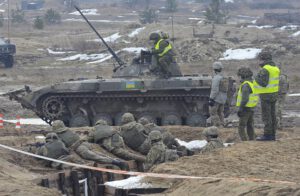
These are no longer just political declarations of intent. The Multinational Force Ukraine has a leadership, a headquarters, and concrete operational tasks. Great Britain and France jointly command the structure. Exercises are intended to demonstrate the force’s capability to actually deploy it after the cessation of hostilities.
This shifts the debate.
For if European soldiers are stationed in Ukraine after a ceasefire, Ukrainian armed forces are further equipped, Western long-range weapons are increasingly manufactured in the country itself, and at the same time economic pressure on Russia continues to rise, the end of hostilities would by no means automatically be the end of the military confrontation between Russia and the West.
It could simply be their next form.
The Coalition of the Willing is therefore not preparing for an escalation of the ongoing war through immediate European intervention. However, it confirms in black and white the preparations for a significantly deeper military entrenchment of Europe in Ukraine – and this could become the next major obstacle on the path to genuine peace.
yogaesoteric
September 10, 2026